Showing posts with label Don Stewart. Show all posts

Wednesday, April 1, 2015

New Technology Sends Pulsations Through Art World

FOR IMMEDIATE RELEASE
Birmingham, Alabama
1 April 2015

Water No-Color Painting

The DS Art Studio is excited to announce the development of a new digitally-based art form with the deceptively simple title of Water Painting.

Alabama artists Don Stewart and Sue Ellen Brown, working with a team of students from the Industrial Design and Engineering departments at Auburn University, have created a new computerized program that allows artists to ‘paint’ the surface of an enclosed body of water, revealing complex, detailed images in vibrant relief.

Using a proprietary software algorithm to synchronize an array of submerged wave generators and micro-pulsating water jets around the periphery of a swimming pool, the husband and wife team of artists has managed to create a programmable system that transforms the surface of the water into recognizable images.

“This amazing technique comprises nothing less than an entirely new medium of artistic expression,” said illustrator and portraitist Sue Ellen Brown, who headed the project.
“Virtually anything you can paint with a brush can now be reproduced in tiny waves of water.”

Brown explained that it’s easy to make circles appear, just by dropping a pebble into a pool. Multiple pebbles make circles that interact with one another, generating more complex, random shapes. The challenge, according to Brown, was to make sense out of the chaos.

“This is our version of the Mona Lisa,” says artist Don Stewart, Brown’s husband and co-owner of the DS Art Studio in Homewood, Alabama, where the new ‘painting’ process was invented.

Stewart stands poolside at the local YMCA, and touches a series of icons on his iPad. The flat surface of the water thrums to life. Within seconds the enigmatic image of Leonardo’s most famous portrait shimmers into focus. A moment later the scene shifts, morphing into Van Gogh’s Starry Night.

“It’s really just a matter of manipulating interference patterns,” says Stewart, who readily admits his lack of understanding of the math required to create the team’s undulating artworks. “It’s unbelievably complicated,” he says. “But that’s why we have computers, isn't it?”

According to the artists, this latest technological advancement offers all sorts of possibilities within the fine art world and beyond, from decorating competitive venues at collegiate and Olympic events, to customizing private pools with portraits of the owners and their pets.

“Imagine, swimmers mount the podium to receive their medals, and the entire pool vibrates into the shape of that country’s flag. That would be impressive, don't you think?” said Brown.
The patent-pending process is currently being adapted for home use, so that people can view pre-programmed art, and design original water-works for their bathtubs and garden reflecting pools.

A micro version of the device could even allow baristas to paint detailed foam images on the surface of espresso orders.

“We’re considering making it an app, so that everyone can use their cell phones to water-paint.” Stewart said.

The artists are seeking investors and potential distributors to further develop their concept. “I can't wait to see what kind of a splash this new technology makes in the Shark Tank,” Brown quips.


Contact:

Don Stewart                www.DSArt.com
Sue Ellen Brown         www.ZooLNArt.com
DS Art Studio Gallery
2805 Crescent Ave
Homewood, Alabama 35209
205-802-4700
1-800-372-7864


####


Tuesday, April 1, 2014

Black Hawks Go Hue-y: Artists Add Color to Military


Birmingham artists Don Stewart and Sue Ellen Brown have forged some surprising alliances with the military in recent years. Stewart’s complex historical drawings have drawn attention and much needed funds to the plight of wounded warriors in the US Army, the Air Force, and the Marines.

Now the team has been asked to add color to the Army’s Black Hawk program. 'Operation Rainbow Hawk' will investigate the possibility of adding a new color spectrum to the livery of an attack helicopter squadron at the Army Aviation headquarters in Fort Rucker.
UH-60 Blackhawk - photo courtesy of Mu Yeol Lee
Gone are the matte blacks and olive drabs that have marked battlefield aircraft since the Second World War.

“It’s kind of an experimental approach,” Stewart said, “With emphasis on the more mental aspects. We’ve been asked to develop new superficial design schemes for a number of purposes, from innovative, “visual stealth” camouflage to public relations and morale. Just thinking of the phrase “Black Ops”, for example, brings all sorts of negative emotional connotations that may not be sympatico with the direction and focus of our modern armed forces.”

Of note is the artists’ plan to outfit the helicopters with advanced urethane coatings, that use tromp l’oeil techniques to fool the eyes of passers by.

“So far we have decked out an old UH-60 helicopter, so it’s now virtually indistinguishable from a vintage school bus,” Stewart said. The artist stated that one such aircraft has been situated in the parking lot of the Galleria mall for over a month without anyone being the wiser, other than noting the unusual amount of engine noise at take-off and landing.
Artistic "Bus" treatment -  photo courtesy Greg Gjerdingen
 “It’s all about using the right palette to create the proper mood,” said Brown, a portraitist and illustrator who is just now applying her talents to military subjects. “It’s fun watching the expressions on peoples’ faces – or the lack of it – when they encounter one of our camouflaged vehicles.”

What’s up next for the team?  “The Navy has asked us to help them re-think the whole ‘navy blue’ thing. That ought to keep us busy for a while yet,” Brown said.

Friday, April 19, 2013

New Elephants on the Table


How many elephants does it take to update a periodic table?

Five.
(So far.)

It’s been ten years since my wife suggested, rather emphatically, that I put all of my ele-mental elephant jokes into a comic mnemonic called the Periodic Table of the Elephants.

That was ten years ago. (Wait, I said that already. Need more mnemonics.)


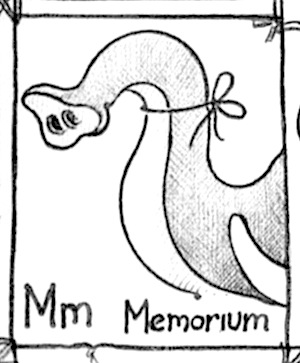
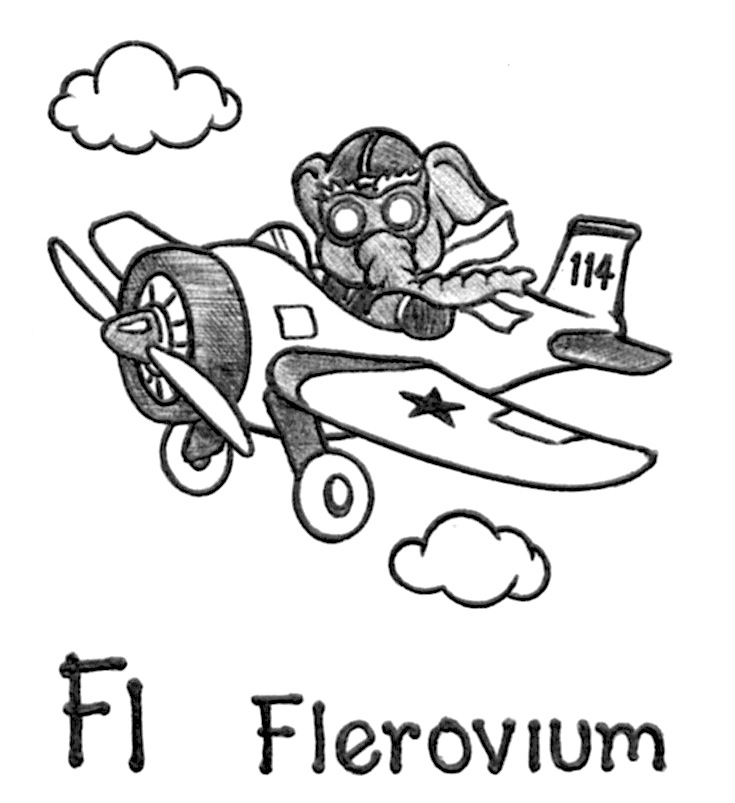
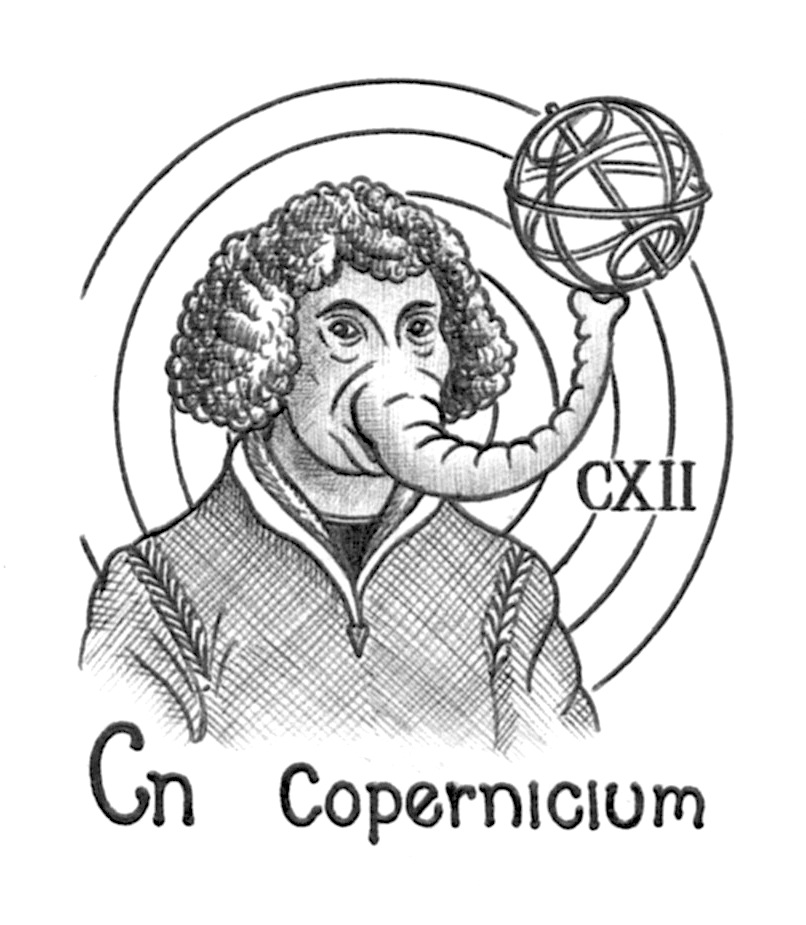
In the meantime, the Almighty Potentates of Chemical Nomenclature have decided to name five new elephants, er, elements. Atoms holding positions # 110, 111, 112, 114 and 116 on the Table have now been christened with new titles by a joint working party of the International Union of Pure and Applied Chemistry (IUPAC) and the International Union of Pure and Applied Physics (IUPAP).

Frankly, I’m a little IUPUT out.

Did the IUPAC or the IUPAP bother to call me, even once, to ask for my INPUT on the naming process? No, they did not. As a result, none of the elephantal appellations that occupy these positions on our original pachyderm chart was adopted.

So, back away from the Table, Republicum, Ivorium, Tuscaloosum, Trunkium and Memorium. You’ve been unceremoniously retired. Go away. Blame the IUPOOPS, not me.


Pull up a chair, Darmstadtium, Roentgenium, Copernicium, Flerovium, and Livermorium. Welcome. Your seats are assured in IPERPETUITY.
 
An endowment for the ongoing support of the retired Elephants has been established in the General Funds section of the DS Art corporate checking account, which will be periodically (sic) maintained via proceeds from purchases of the few Original Periodic Table of the Elephants posters that remain in stock. 


While supplies last.

The New, Improved, and Updated version of the Periodic Table of the Elephants will appear on store shelves worldwide, or at least on the DS Art website, in short order, after I pause to collect myself.

Any further emotions will be tabled until our next meeting.


Saturday, April 13, 2013

Past Medical History


Once upon a time I wrote a book. Actually, I have been writing for years, usually during the slow art selling season around January and February, before art show activity picks up again in the springtime. Short stories, mostly, very much like the ones that get posted here. 
Owl


This year, though, I was talking to a friendly professional acquaintance who is a writer, a real one, a famous one, who also publishes a line of his own books. I asked him if his company would consider publishing my next coffee table book, a collection of medical drawings that I've been threatening to print for a really long time. (Just as soon as I finish the drawings, which have grown from twenty, to thirty, to now nearly sixty, and still only ten or fifteen to go.)

He politely said no - picture books are not the kind of thing they do - but he did express some interest in another project I had in mind, maybe in another year or two from now, when I could pull together enough short stories to make it work. I figured I would need around thirty of the short stories I'd been working on, sporadically,  to tell my story - the tale of a young doctor who up and quit the business one day, and somewhere along the way decided to become an artist. Seemed like a story worth telling, and I thought I had a good start, somewhere in a file folder on my computer.

So I looked for a file called "Medical Book", where I soon discovered there were nearly100 documents gathering virtual dust, some long, some short, the majority of them already finished, each waiting quietly and patiently for a final edit.

In no time I was able to pull together 45 of these short essays, arranged them in loose chronological order, and discovered that together they constituted the arc of a story. I had a book.

Past Medical History was  born. 


Nothing to do but try and get it published. 


My friend the writer is swamped with other projects. He and others in the industry (in fact, everyone I knew who was even remotely associated with the publishing biz) told me there was but one alternative: Pitch my book to an agent, who would then pitch my book to a real, mainstream publisher.

Such began a process of self-education that has now lasted a couple of months, an adventure that has been at least as complex and fraught with pitfalls as anything I ever encountered in medical school, involving the multiple and oft-counterexclusive paths of mainstream publishing, vanity publishing, self- and assisted self-publishing, e-publishing, POD and POD (yes, there are two, sometimes used interchangeably), and giving up entirely. Not to mention e-mails, Query Letters, Synopses, Biographies, Overviews and Hooks, each an essential part of the cryptic language that transcends common business communication in meaning, intensity and importance.

What's more, there is a formulaic family of documentary formats that must be scrupulously followed in applying to publishing representatives of all stripes, no matter what their submission guidelines may imply to the contrary, with the added challenge of subtle, agent-specific, custom modification requirements representing a maze of tripwires in a minefield of minutia that all but guarantees failure for the novice writer. 

And all this just to convince someone to agree to accept a manuscript for review.

It has been, and remains, a challenge. But we persevere, and by now a formal Book Proposal for Past Medical History has been crafted, meticulously formatted, and recently posted on Scribd, should any sympathetic book agents or editors find their way here to catch the link (and perhaps tell me which portions of the proposal must be double-spaced, as opposed to those pages that will cause the entire project to be scrapped if they are mistakenly made so). In the meantime, all are invited to follow along with me on Facebook to watch as this adventure continues to unfold.

Please bring coffee.

Wednesday, October 3, 2012

Stewart's Train a BIG Draw for Kids in Chicagoland


Ballpoint artist Don Stewart draws composite images, which he describes simply as “Big pictures made out of little pictures.”

Now one of his pictures is really big.

The DuPage Children's Museum in Naperville, IL has enlarged one of Stewart’s drawings to more than ten feet across, filling an entire section of the wall in the museum’s new interactive display titled TRAINS – All Aboard Art!

Kids of all ages will now have no trouble seeing everything hidden in Stewart’s drawing of an old steam locomotive, built entirely of antiques from a bygone era.

Coupled with an on-board train camera, train tracks to assemble, train books and art projects, the new installation will “keep young hands and minds busy as children discover the wonder of train transportation,” according to the museum’s web site.

(Photo courtesy of DuPage Museum)

“Families are really enjoying the art and the activity,” says Marcia MacRae, Interdisciplinary Arts Specialist at the DuPage Museum. 

In 2007, McRae included another of Stewart’s drawings, a motorcycle made of “Fast Food”, in a museum display on nutrition.

Sunday, September 2, 2012

Making Movies, Standing Still


Thanks to the magic of do-it-yourself movie-making software, the DS Art studio has begun producing a series of fun little videos, featuring the artwork of DonStewart and Sue Ellen Brown.


Actually, Sue Ellen does all of the heavy lifting on these projects. Don sits nearby bothering her with inane questions and comments, like “That looks too dark,” or “Can you make it scroll backwards?” and “Shouldn't we add another comma there?”

Sue patiently works her digital wizardry, and before long we have another masterpiece to add to the collection. What used to be still, silent drawings and paintings come alive with movement, narration, and mood-moving background music. She even throws in some clever sound effects now and then for good measure.

So grab a friend and a bowl of popcorn, and come take a look: 

Wednesday, August 29, 2012

Nobody Listens to Artists


It only took a week of being a full-time artist to learn one of the abiding truths inherent in this business: Nobody listens to artists.

Truly, the quickest way to get a door slammed in my face was to say something like,

“Hello, I’m an artist, and I’d like you to look at a few of my…” SLAM!

Nothing could shut down a business conversation faster than uttering the A-word in the first person. Ad executives, gallery owners, architects, store managers, business administrators, charity directors, teachers – all dismissed me routinely, usually before I had the chance to show them any of my artwork.

“Leave a card and we’ll call you if we need you.” Operative word: Leave.

Friends and relatives often responded similarly, with a modicum of disappointment and a quick sendoff, occasionally leavened with a polite, sympathetic smile thrown in to make me feel better, and visible relief at my (hopefully) hasty departure.

This was a big change from how I was used to being treated, a completely unexpected consequence of my decision to step out of the hospital and into the art studio.

                                                  Quack

Sure, I understood that ‘art’ was, generally speaking, a hobby, for most people a diversion rather than a calling. For me though, my career change was just that, and nothing less than that – a move from one profession to the next. I had the talent and the drive to succeed as an illustrator and a designer, and I had the work to prove it. Besides, with degrees in biology and medicine, I had the background to handle drawing assignments on subjects ranging from wildlife to healthcare to robotic technology. Why was it so hard getting anyone to pay attention?

As a doctor, I was accustomed to being taken seriously - often a little too seriously for my liking. That’s one reason I wanted to explore the arts, to get away from the regimented solemnity and enforced humorlessness of the hospital.

The trouble was that
 artists aren't professionals.

After years of academic and clinical training, I knew how to conduct myself professionally, to communicate clearly and concisely in a face-to-face interview. I did my homework, too, staying up late planning schedules and strategies, following leads, putting together a balanced mix of appointments and cold calls. I arrived for meetings in plenty of time to review my presentation, and my appearance: Combed hair, shined shoes, business suit, tie with matching pocket square, fashionable overcoat.*

Heck, I even carried an expensive leather (leather!) artist’s portfolio chock full of my work, neatly arranged in an understandable, logical progression from graphic design to illustration to my own brand of composite drawings. I showed up with a positive attitude, a firm handshake, and a winning smile.

“Oh. You’re the artist. Leave a card.” Such reactions were as baffling as they were consistent.

Lacking experience to the contrary, I assumed people in one line of work respected the ability of others to perform well in their chosen professions, at least until they had demonstrated otherwise. The trouble, I came to understand, was that artists aren't professionals.

Artists are a lot of things. We’re thoughtful, innovative, hard working, and usually we’re an awful lot of fun. We’re free spirits, too: Quirky. Eccentric. Weird. In the world of business, that makes us strange, and suspect. And since our work schedules seldom fit the usual nine-to-five routine, we’re often considered unreliable and irresponsible, or worse, lazy, living off the sweat of others who aren’t afraid to put in a full 40-hour work week.

But we’re not professional. Professionals are people with real jobs. Professionals work for someone else, every day, for a thing called a regular paycheck. We free-lance artists work for ourselves, at whatever assignments we can get, for whatever pay we can negotiate. And once we’ve successfully completed a project, we’re… what’s the word? Oh, yeah… unemployed.

The working world seems to frown on this business model. Projects come through or they don’t, feast or famine, with frequent interruptions in cash flow. For beginning artists especially, these uncertainties make it difficult to secure adequate housing and studio space, or to make regular payments on car notes or insurance premiums (assuming loans or insurance coverage are even available). Even artists with long track records, substantial client lists and above average business sense are vulnerable to dry spells that can unravel years of financial success.

So, art is not a real profession, it seems, unless you happen to be a real professional artist. We all know a number of these. They’re household names. The ones whose work we recognize. As a rule, they died a long time ago.

Then there are the few successful artists who live and work outside of the stereotype. We know their names, too. We recognize their work. We might even recognize them if we saw them on TV, or hanging out at a restaurant downtown. We understand that they get paid a lot of money for their art, and we wish that we had bought one of their pieces years ago when it was affordable, before they became well known - before the world recognized them as professionals.

That’s the second enduring 
truth of the art business: 
As soon as someone other than you 
likes your work, and is willing to tell 
someone else about it, you’ve arrived.

But how do you know when you, as an artist, have crossed that line? How do you tell when you’ve made it?

That’s just it. You don’t. Someone else tells for you.

That’s the second enduring truth of the art business: As soon as someone other than you likes your work, and is willing to tell someone else about it, you’ve arrived.

You can't be that person. Your squeak won't grease your own wheels.

“Hi, I’m an artist, and my work is awesome!” will get you nowhere.

Fortunately, though, that ‘right person’ can be just about anyone else:

“Hey, have you seen this dude’s work? It’s awesome!”

That kind of recommendation will get you recognition, and sales, and contracts to make more of your art. If you are fortunate enough (and persistent enough) to string together a number of recommendations like this, you just might stay in business long enough to build a career in art.

Our business plan at DS Art is built entirely around these two truths. We want our clients and customers to be happy with our work, and our work ethic. We understand that every piece of artwork that leaves our studio is an ambassador for our future success, and that every customer we earn becomes a potential cheerleader for (or against) our creative ability, our professionalism, and our future .

Just don't take our word for it.


*In hindsight, this could have been part of the problem. I can recall but one episode in those early days when I received a bona fide art commission, entirely on my own. The client was in a bind, facing a tight deadline. He needed to speak with someone right away, and would meet with me only if I could get to his office within the hour. That office was more than 50 miles away, which left me no time to shower, shave, or even change clothes. I jumped in the car and drove to the meeting ‘as-is’. The client took one look at my scruffy weekend beard, dirty sneakers, worn jeans, and rumpled jacket, and instantly awarded me the job. Apparently he needed an artist, rather than a professional.