Showing posts with label persistence. Show all posts

Wednesday, June 10, 2015

“I Can’t Draw Stick People.”


Yes, You Can.
The real question is, how bad do you want to?*
Frankly, I’m not sure how well I can draw a stick person, either.  I’ve seldom been asked to. Hands, though, I’ll grant you. Hands are hard to draw. Lots harder than stick people. I know this because aspiring artists tell me all the time. Hands are just impossible.  

“I tried to draw my hand once, and it looked AWFUL,” they say.
“I know,” I tell them. “But how did it look after you drew it 100 times?”

Trust me: If you have an interest in drawing, and you take the time to draw the same thing eight or nine dozen times, the later attempts are going to look better than the first ones. It’s one of the overarching rules of art: “Practice Makes Perfect Better.”

No, I’m not saying that repetition alone will make you better. After all, doing the same thing over and over again expecting different results won't just drive you crazy, it is crazy. But practicing your craft, hour after hour, day after day, cannot help but make you a better artist.

Pausing in between drawings to look – really look – at how hands are constructed, looking closely at photos of hands in magazines, finding art books or online drawing lessons that help you see how hands are constructed, then studying the anatomy to see why they are constructed that way – these are the steps you take as a seriously curious person to become the artist you want to be, and to solve the difficult problem you have set before yourself. This is what helps you to see and understand your subject, and improves your ability to draw.

If, after drawing your hand 100 times, your work hasn't gotten any better, now at least you know that drawing probably isn’t your thing.

Unless – and here’s another caveat – you actually enjoyed drawing your hand badly a hundred times over. Some people do. Some folks enjoy making lousy art, and have no problem telling you so. If you’re one of those people, draw on, my friend. Have at it!

Because frankly, that’s who we all are, to one extent or another. We all have things that we draw well, and things that we have trouble with. And few of us can ever draw anything well enough to satisfy our worst critics – the ones who live inside our own heads.

I can’t draw cats, but that doesn't stop me from drawing a lot of them, badly. (Other people might tell me they look okay, but I know the pictures suck. I know what they were supposed to look like, and how far I have to go to achieve that level of accuracy.)

Happily, all of us can get better, and we will if we practice, and pay attention, and work on improving every time we sit down to amuse ourselves at the drawing table.

Ira Glass explains it really well, here.


Remember, your standards for excellence are already unreasonably high, or you wouldn't be trying to achieve the impossible – trying to make art. After all, art, to most people, is simply another form of magic.

Like everything else, being a good magician takes practice. Fortunately the best part about practicing drawing is… you get to draw while you're doing it.


*(Yes. That was written badly. Or at least it should have been, to be grammatically correct. I chose instead to be conversationally correct. I promise to stay after school and write the sentence properly, 100 times.)

Friday, February 1, 2013

What We’re Here For


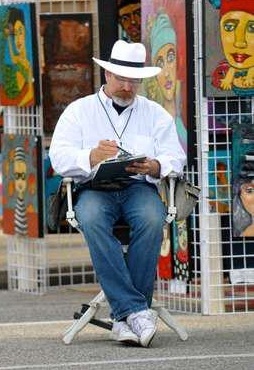
Back then I was still new at this business, presenting my work to the public in a bona fide art show. I busied myself with setting up a folding table and a couple of easels, balancing anticipation with anxiety, trying to act like I knew what I was doing.

An older man knelt in the space across from mine, fitting together the pre-formed sections of an expensive, professional-looking display. He looked up and smiled.

“What are you here for?” he asked.  

“To sell pictures,” I replied confidently.

“No you're not,” he said, his expression now matter-of-fact, the smile still dancing in his eyes.

Is he kidding? What else would I be doing here?

“Then what am I here for?” I asked, a little incredulously.

“You never know, until after the show is over.” He paused intentionally for dramatic effect.  “Sometimes long after.” 

He held my gaze a moment longer, then turned back to his work.

That was more than a quarter century ago.

His words have stayed with me over the years, have haunted and strengthened me through hundreds of art shows, good and bad. It took a long time for me to understand what he told me that day, even longer to appreciate the value of hearing it early in my career as a professional artist.

He was right, of course. I was hoping to make a month’s rent at that show. More to the point, I needed to make a month’s rent at that show. In my head, I’d worked out all the ways I could generate five hundred dollars, selling $20, $25, and $50 prints, in every conceivable combination. I had my pictures hung, cash box and receipt book ready, a brand new box of business cards, and a boatload of enthusiasm.

What I didn't have was the two-dollar inspirational refrigerator magnets that the lady in the booth next to me had. They were the going thing that weekend, and she sold hundreds of them. Customers lined up all day, every day, using my table to rest their purses while they dug for checkbooks and change.

I went home that weekend with forty bucks, and the understanding that things don't always turn out the way you want them to.

Every art show has its grumblers, people who believe there should be better weather, wider promotion, quieter neighbors, lower booth fees, more customers, more sales, more money.  Sometimes I’m one of them.

At that point I try and remind myself that I’m not just there to sell pictures. I may be there to meet people, to build business relationships, to be inspired by other artists, to give an encouraging word to a beginner. Maybe I’m there to capitalize on the quiet time, and jot down ideas for future drawings.

I’m definitely there to hand out cards and brochures to anyone who is even remotely interested in my work. (If people can’t see what I do for a living, it’s a sure bet that they won't give me enough money to keep doing it.)

Sometimes it takes years to notice the benefit of a ‘zero’ show, to see evidence that the long-term investment of energy and optimism has actually paid off. We always enjoy getting orders from cities we have never visited, from people who tell us they first saw the pictures at a little out-of-the-way art show in Whoshotjohn, Wisconsin. Once a new customer called the studio to make a purchase after finding our flyer in the glove box of a used car she had just purchased. We had never even been to her part of the country, but someone, somewhere had stopped by to see us. The flyer was more than ten years old.

“What are you here for?” is a question I ask myself now, before every show. Maybe I’m there to sell pictures, or just maybe I’m there to pass along a gift I received a long time ago, when a veteran artist cared enough to poke his nose into my business.

I never know until after the show is over.